Abelian joins the HKMA and Hong Kong’s banks on quantum resilience
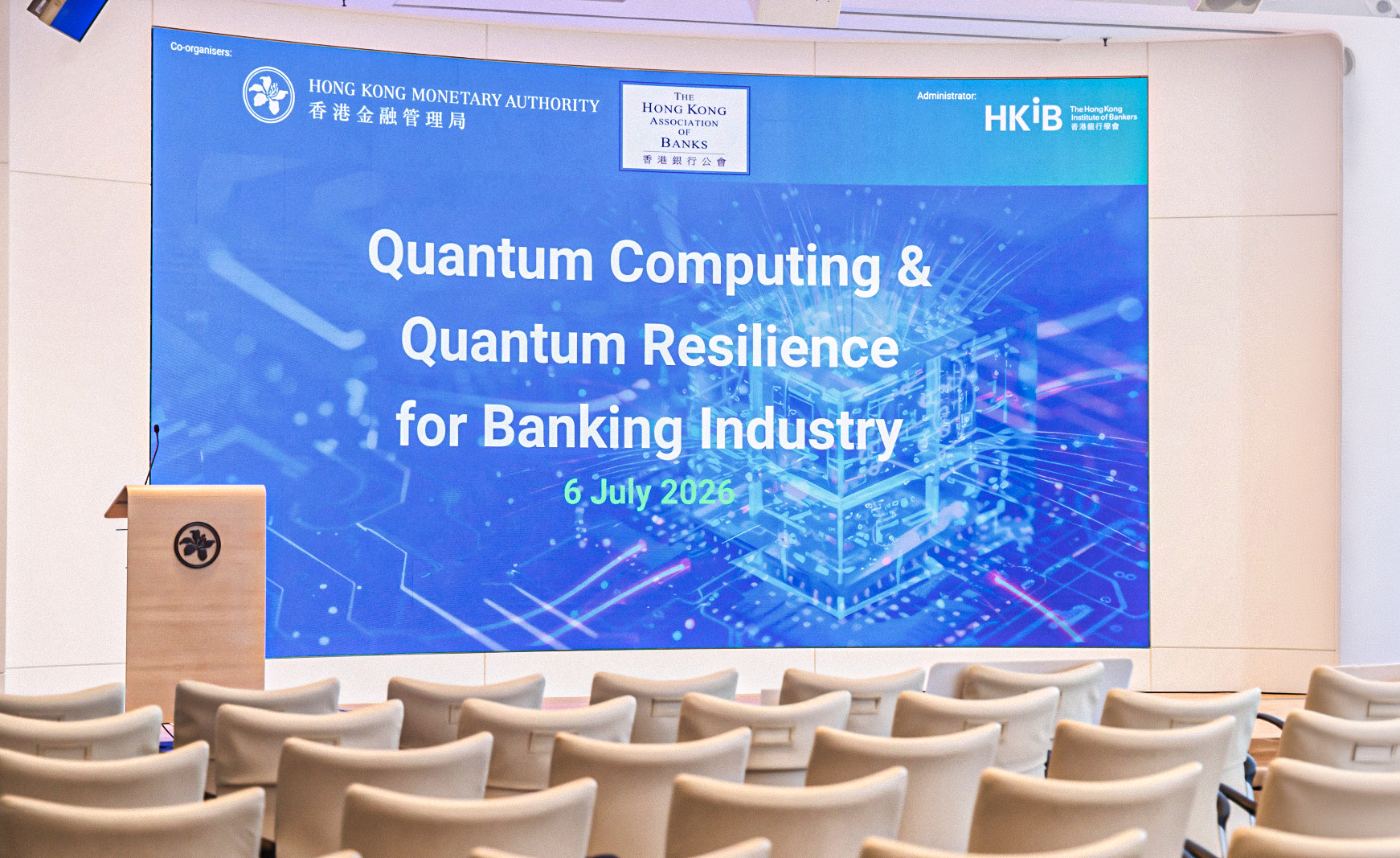
On 6 July 2026, Abelian took part in Quantum Computing & Quantum Resilience for Banking Industry, a seminar co-organised by the Hong Kong Monetary Authority (HKMA) and The Hong Kong Association of Banks (HKAB), and administered by The Hong Kong Institute of Bankers (HKIB). Close to 200 participants from 63 member banks filled the room to confront the question Abelian was built to answer: what happens to the world’s financial infrastructure when the cryptography beneath it stops holding?
Quantum risk is now a supervisory metric
The timing was not incidental. In February 2026 the HKMA unveiled its Fintech Promotion Blueprint under “Fintech 2030,” and the first of its four flagship projects is a Quantum Preparedness Index — a measure of how ready Hong Kong’s banking sector is for post-quantum cryptography (PQC). The regulator’s framing is telling: the Index is designed to deliver a current-state analysis, set a measurable target for the next few years, and guide practical support throughout what the HKMA calls the PQC transition journey. Quantum risk has moved from a research topic into something a supervisor intends to measure.
That urgency set the tone. Opening the seminar, Arthur Yuen, Deputy Chief Executive of the HKMA, described the future banking workforce in three parts: technical depth; human soft skills — creativity, empathy and the ability to work with others; and judgement and knowledge. The banks of the future, he argued, will be built by people who understand both technology and trust — and as automation deepens, those human skills matter more, not less. On quantum he was blunt: banking must understand the impact, and plan ahead for what to deploy, and when.
[Banks] needed to start preparations today, before the first attack.
— Arthur Yuen, Deputy Chief Executive, HKMA
The point was reinforced by Wang Huabin, Chairperson of HKAB and Deputy Chief Executive of Bank of China (Hong Kong), who anchored the morning in the HKMA’s DART framework — the Data, AI, Resilience and Tokenisation pillars of Fintech 2030 — under which quantum resilience sits squarely in the “R.”
Quantum 101: what the banks wanted explained
Before the panel convened, the organisers invited two speakers to deliver individual sessions in their fields of expertise: Duncan Wong for Abelian, and Peter Lee for IBM. That structure is worth noting. When Hong Kong’s regulator and its banks wanted the cryptography explained, Abelian was one of two firms asked to explain it.
Duncan’s session moved from classical versus quantum processing to what he called the duality of quantum advancement — value creation on one side, cryptographic vulnerability on the other. RSA at 2,048 or 4,096 bits, and elliptic-curve cryptography, comfortably resist classical brute force. Shor’s algorithm, published in 1994, removes that guarantee once a sufficiently large, error-corrected quantum machine exists.
From there he set out the harvest now, decrypt later problem and the quantum risk window: three variables — how long your data must stay secret, how long migration will take, and how long until Q-Day. If the first two together exceed the third, you are already late. He mapped the migration path regulators are converging on, from RSA and ECC toward the NIST PQC standards, and closed with an architectural case study drawn from blockchain: roughly one million bitcoin sitting in early Satoshi-era wallets whose public keys are already exposed on-chain — a standing reminder that “encrypted today” is not “safe forever.”
Peter Lee, Chief Technology Officer of IBM China / Hong Kong Limited, followed with the industry’s clock: Google’s quantum team places Q-Day around 2029. He walked the room through the difference between asymmetric (public-key) and symmetric cryptography — the two schemes on which nearly every financial system quietly depends.
The dual edge, on the panel
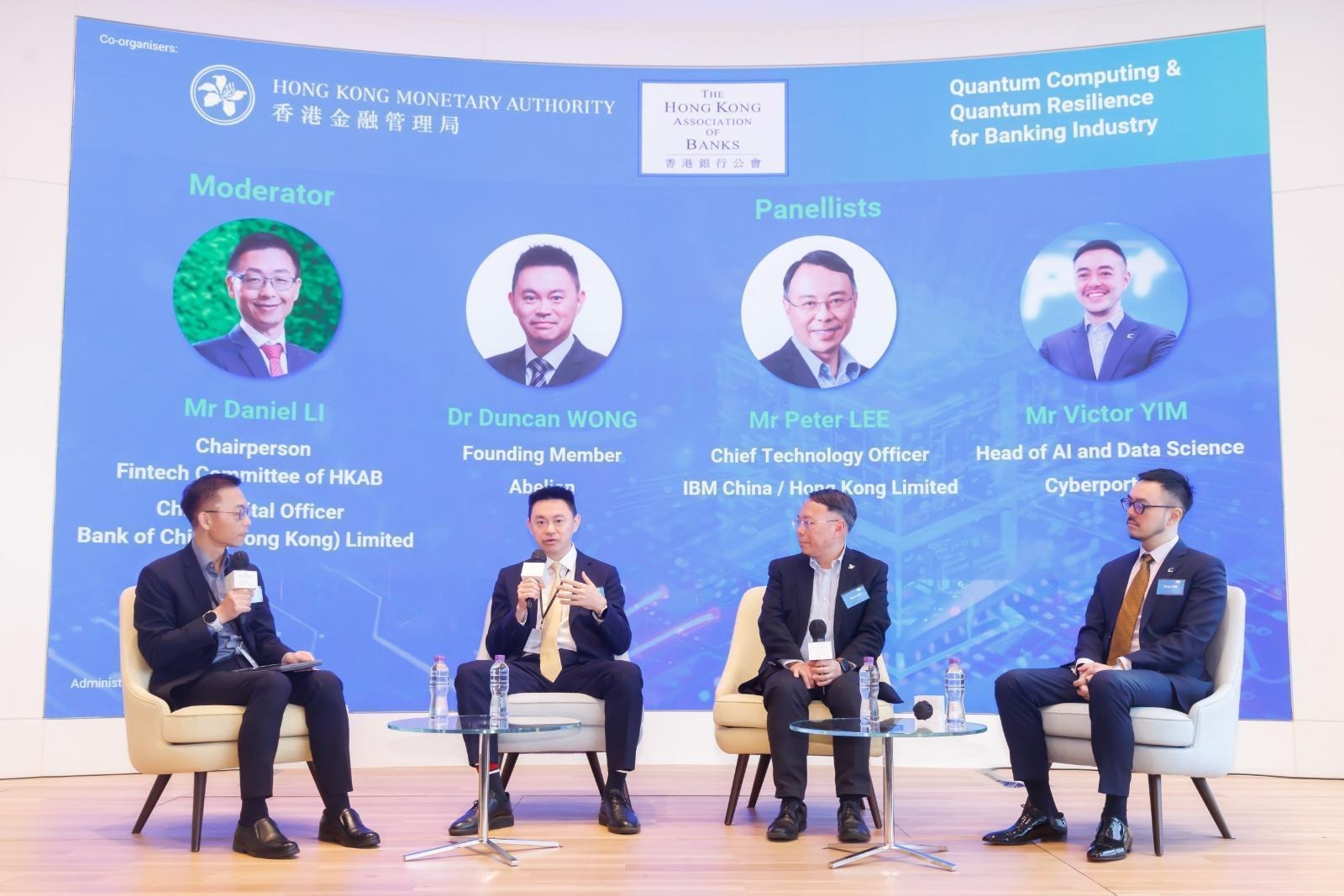
The panel brought the threads together. Duncan and Peter were joined by Victor Yim, Head of AI and Data Science at Cyberport, moderated by Daniel Li, Chairperson of HKAB’s Fintech Committee and Chief Digital Officer at Bank of China (Hong Kong) Limited. Duncan framed the dual edge of quantum advancement: the same machines that promise breakthroughs in drug discovery, financial optimisation and artificial intelligence also threaten the public-key cryptography that quietly secures every payment, settlement and custody record in the system. Members of the Abelian team were also in attendance.
Why Abelian keeps showing up
This is precisely the gap Abelian was built to close. Most of the industry’s PQC conversation is about migration — retrofitting quantum-safe algorithms into systems designed for a pre-quantum world. Abelian took the other route. We built a Layer 1 that is post-quantum from genesis, using lattice-based cryptography rather than the elliptic-curve signatures a sufficiently capable quantum computer would eventually unravel. That makes Abelian less a proposal than a proof point: quantum-safe infrastructure that is already live and running today.
For banks, whose records must remain confidential for decades, the clock started long ago. A regulator that measures preparedness, an industry that plans ahead, and infrastructure that is quantum-safe by default are three parts of the same answer — and none of them works alone.
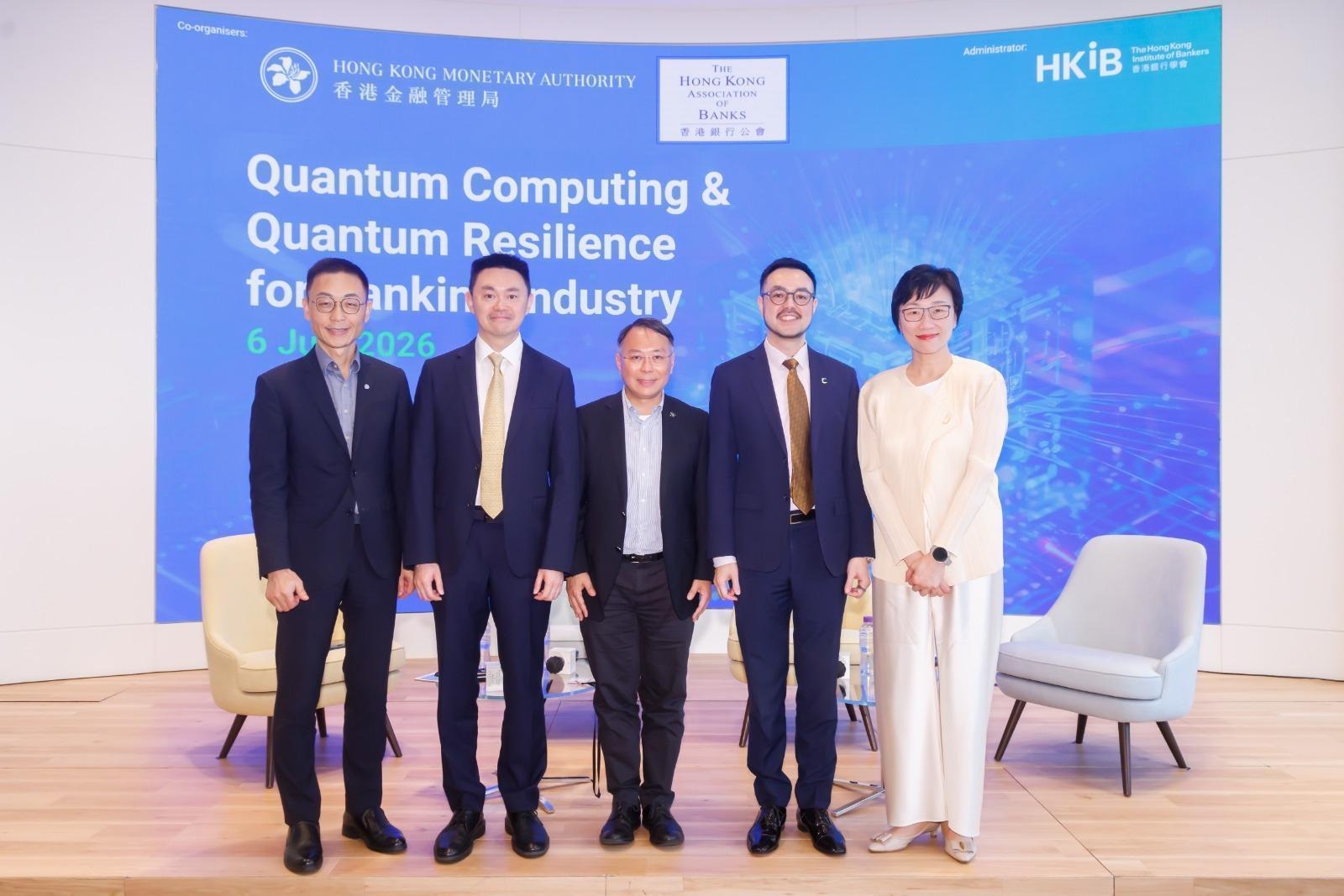
Our thanks to the HKMA, HKAB and HKIB for convening the conversation, and to our fellow panellists for a candid one. As pioneers in quantum-resistant blockchain technology, Abelian remains committed to helping the ecosystem transition smoothly into a secure future. The quantum era is arriving quickly. The institutions that prepare now are the ones that will still be trusted when it does.
Media Links
Website: https://www.pqabelian.io/
X: https://x.com/PQabelian | https://x.com/HAKOMETAL
TG: https://t.me/pqabelian | https://t.me/pqabelian
YouTube: https://www.youtube.com/@PQAbelian
LinkedIn: linkedin.com/company/pqabelian

